


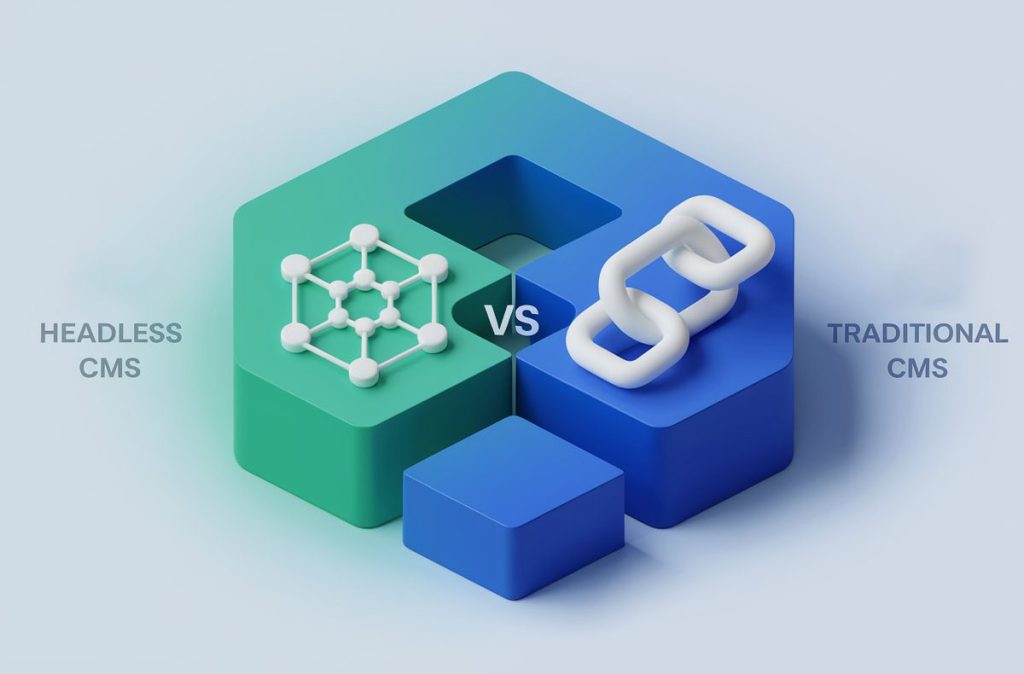
It is like arranging to set up a new cafe. You have two choices: an already designed space where everything from the color of the walls to the furniture layout would not be changeable; or an open space where you can customize every detail to your liking. This analogy is for Traditional Content Management System (CMS) and a Headless CMS in web development. You will understand their difference by reading these points, and so determine which of the two would be best for your business.
Traditional CMS: The All-in-One Package
Just like pre-built café premises, a Conventional CMS such as WordPress or Joomla does serve the same purpose. It also integrates content management (the backend) with the presentation layer (the frontend). It provides the platform to create, maintain, and publish all types of content under its umbrella.
Pros:
- User-Friendly: Setting up and managing a website is relatively easy for those who are not developers, as built-in themes and templates are available.
- Potentially Lower Initial Cost: Many of the traditional CMS platforms are open-source, which can result in a lower initial setup cost. However, long-term costs can vary significantly based on customization, maintenance, and hosting needs.
Cons:
- Inflexibility: Customisation beyond the templates provided could seem challenging and might need substantial coding skills.
- Performance can be affected by architecture: Performance in traditional CMS platforms depends heavily on factors like hosting quality, theme optimization, plugin usage, and caching strategies. Well-configured traditional CMS platforms can achieve good performance.
Headless CMS: The Customizable Canvas
In contrast, a Headless CMS is such a cafe, which is opened and customized according to the needs. It focuses only on content management, providing content through APIs to any of the frontends or devices. This decoupling allows developers to design the presentation layer independently and offer greater flexibility.
Pros:
- An omnichannel approach allows content to be published similarly across different platforms—be it on websites, mobile apps, or IoT devices—ensuring consistent user experience.
- A website usually loads faster and is usually more scalable with a decoupled layout.
Cons:
- With the front-end development work done by a team, we anticipate an increase in initial development costs and complexity.
- When it comes to the default presentation layer, there is an absence; hence, custom development for a front-end interface is excluded and that makes all the difference from those ‘traditional’ CMS systems.
Actionable Tips for Beginners: Navigating the CMS Landscape
Examine Your Needs: If your needs are for a website with simple functionalities, a Traditional CMS would be the best option. On the contrary, if you are looking to build a multi-platform presence with personalized experiences for users, you should be considering using a Headless CMS.
Resources: Gauge the level of technical expertise possessed by your team. A traditional CMS platform allows people with little or no coding skills to be productive, whereas a Headless CMS will require a capable development team.
Scalability: You might want to consider your future needs. If extensive growth possibilities correlate with notable integration efforts between platforms, then a Headless CMS does hold a better advantage for scalability.
Final Thoughts: Making the Choice
The choice between the traditional and the headless CMS is akin to choosing between a ready-for-use apartment furnished to taste and a personally constructed house. Hence one is convenient and simple, the other is flexible and customizable. Consider business objectives versus technical capability, along with the desired user experience. Have you ever faced challenges with your CMS installation? What is the plan for content delivery in the future? Answering these questions will guide you down the right path for your unique scenario.